YW Staff Explores Black Asheville with Hood Huggers
About 40 YWCA staff recently spent an afternoon on a guided tour of Black Asheville with Hood Huggers International, a community-centered organization focused on art, sustainability, and social enterprise in the Black community to build up Affrilachia (the culture and lived experiences of Black communities in Appalachia, highlighting African American contributions to the region). The projects and plans of Hood Huggers are diverse and far reaching, but on this day, we got a sampling of the kinds of things that Hood Huggers, and founder DeWayne Barton, are passionate about.
Learning about Asheville through this lens matters to our mission of eliminating racism, empowering women, and promoting peace, justice, freedom, and dignity for all. Black history is Asheville history. It is our shared history.
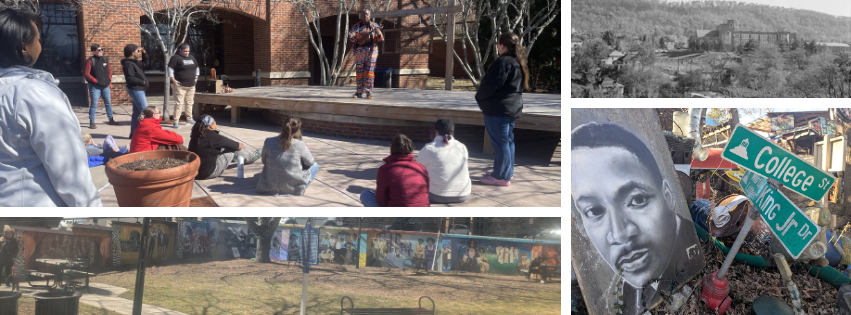
After an all staff group photo the day began with Kelle Jolly singing old spirituals and reminding us these songs carried people through marches for freedom and still matter today. Her voice set the tone before we split into two groups, one led by DeWayne and the other by Kelle.
At Stephens-Lee, we stood where an all-Black high school once served students from across nine counties in Western North Carolina. Many traveled long distances to learn from teachers who demanded excellence. When integration came in 1965, those teachers lost their jobs and that foundation was dismantled. The building is now the Stephens-Lee Community Center, operated by the City of Asheville Parks & Recreation. It remains a place for after-school programs, recreation, and community gatherings, carrying forward its role as a space where Black families built connection and opportunity.
The next stop was Triangle Park, Market Street, and the YMI Cultural Center. Market Street is the historic Black business district, built on the site of Asheville’s 19th century slave market. A mural now stands there, honoring the lives and stories of those who were sold and enslaved. The Young Men's Institute (YMI) was built in 1893 as a place of respite for the black folks working for George Vanderbilt and his expansive Biltmore Estate. It was a community hub for black families, and today stands as a testament to the vision of Issac Dickson and Edward Stephens, the prominent Black educators who approached Vanderbilt with a proposal for a cultural center back in 1892.
Our final stop was the Peace Garden in the Burton Street neighborhood. Sculptures and gathering spaces built from reclaimed materials reflect the neighborhood’s creativity and care. The garden hosts a small library, classes, plant sales, and markets during the warmer months. It is both art and infrastructure.
On our way out of the Burton Street neighborhood - which is endangered by the coming I-26 interstate connector expansion - we drove by the future site of the Blue Note Junction, described as "an off-grid community resilience hub — combining emergency shelter, environmental education, cultural preservation, and local business incubation under one roof." DeWayne explained that the goal of the project was to mitigate some of the degrading effects of highway expansion. Too often, those expansions have harmed historically Black neighborhoods.
One staff member shared:
Any time I go on a tour like this or take a racial justice workshop, all I can feel is a sense of loss and degradation. It is with me constantly as I move through this world in a Black body. Being Black in America is to be in a perpetual state of grief, at least for me. Grief for what is, grief for what was and the lost potential, and grief for a more unified future that never seems to come.
That reflection stayed with many of us.
Understanding this history is not separate from our work at the YWCA. It shapes it. If we are serious about eliminating racism, we have to know the full story of the place we call home, including the parts that are uncomfortable. We have to understand how displacement, policy, and investment decisions continue to shape neighborhoods today.
Listening matters. Learning matters. What we do next matters most.
If you are interested in diving deeper into issues like what does racial justice look like, and how, and where, can we have important conversations to truly transform the way we understand race and racism, and each other, then our Racial Justice Workshops are for you.
Learn more here about the work of Hood Huggers International and support their efforts to preserve, protect, and uplift Black communities in Asheville.